• Home
  • Contact
  • Archive
  • Resources
  • Events
  • Home
  • Contact
  • Archive
  • Resources
  • Events
POETRY & POWER

ideas are bulletproof

4/28/2016

0 Comments

 
I meant to post this after LOMA came to visit, but I didn't have access to the blog at that point....figured I'd post it now. We had a poet come visit recently—LOMA, look him up—and he made a comment about the power—or impact—behind words. I’m definitely paraphrasing, he said he’s careful about the words he chooses because of the impact they can have in the realm of interpretation—“this is a chair because I say it’s a chair”; the word chair summons up our own connotations…That notion—the notion that once you say something, the words cease being yours alone and become capable of something more than is one reason I love words as much as I do…it’s also a reason speech can be so empowering, or dangerous.
            Talk isn’t as cheap as we think. Before action comes intention and idea--Beneath this mask there is more than flesh. Beneath this mask there is an idea, Mr. Creedy, and ideas are bulletproof (V for Vendetta…) Ideas don’t die easily—they’re like Jason from Friday the 13th, unforgivingly relentless. If you’re a fan of N.W.A—or if you’ve seen Straight Outta Compton—you’re aware of the power they inspired within their communities, and the fear these young black men inspired within white power structures, with a song titled “Fuck Tha Police”. The song starts like they’re at a court hearing, starting with Ice Cube taking the stand. Some excerpts:
 
Excerpts from Ice Cube’s verse, and by far my favorite—that man is a poet, No Vaseline is just an incredibly large and well written middle finger to the remaining members N.W.A.
Fuck the police coming straight from the underground
a young nigga got it bad cause I’m brown
and not the other color so police think
they have the authority to kill a minority
Fuck that shit, cause I ain’t the one
for a punk mother fucker with a badge and a gun
to be beating on, and thrown in jail
we can go toe to toe in the middle of a cell
Fucking with me because I’m a teenager
with a little bit of gold and a pager.
Searching my car, looking for the product
thinking every nigga is selling narcotics.
You’d rather see me in the pen
than me and Lorenzo rolling in a Benz-o
 
Excerpts from MC Ren’s Verse
For police I’m saying, “Fuck you punk!”
Reading my rights and shit, it’s all junk
Pulling out a silly club, so you stand
with a faek-ass badge and a gun in your hand
but take off the gun so you can see what’s up
and we’ll go at it punk
and I’ma fuck you up
 
The popularity of N.W.A.’s lyrics prompted the then assistant director of the FBI, Milt Ahlerich, to send a letter to Ruthless Records—founded by Eazy and Jerry Heller—and to Ruthless’s distributors Priority Records condemning the lyrics. Police actively refused to provide security for N.W.A.’s concerts, and in some cases actively attempting to stop concerts from happening.
 
And this was all in the late 80’s, right before the 1992 L.A. riots. Not that N.W.A was single-handedly responsible for the riots, but the content of N.W.A.’s lyrics were speaking to the violence black US citizens were often subjected too. N.W.A. validated the “normal” person’s experience—these famous rappers were telling their story. It happened everywhere, to everyone. N.W.A. was more than just a band, it feels like N.W.A is a part of Los Angeles’s—and the US’s—troubled history of racial relations.


Words are powerful because of the ideas and experiences they represent—which is why poetry, as well as lyrics, can summon such emotional responses. But I think it’s dangerous attempting skirt difficult ideas, or to censor one’s self because of someone else’s interpretation. Not all words are pretty, but I believe they are all necessary. 


--Macaully Shields
0 Comments

Slam for lunch?

4/26/2016

2 Comments

 
Lunch...My favorite class period, where I learn the most information that actually applies to the growth and development of my character was somehow different on 4/22. Instead of my lunch consisting of regular "tea-time" as my fellow classmates refer to daily gossip, we was served with Slam Poetry! Joy started this rotation of extremely hot poetry with one of her own poems about self ignorance which I still to this day reflect upon! Many of our classmates were extremely shocked to see Joy share such a powerful poem due to her timid personality. Her poem had left many of us excited to see more performances and poetry. (You rock Joy!)

After Joy, we had Davon silence the room completely with her poem stating "But see, ya'll don't dream a woman into Africa until she's gone, write her poems and tell her how much you miss her but never actually lay claim to her." Which had many of the males in the room on hush mode with that big bite to swallow. (Appreciate women! Appreciate BLACK women) Reflecting on this poem still has me in awe on my worth and the worth of the many Queens before and after me. 

While mouths were still gaping, A very well known voice throughout City College had something big to say with a little motivation from me of course! Tobias tried to act like he wasn't a poet at heart with a message, so I had to kindly remind him that I know he wrote poetry because we used to rap in our Sophomore technology class. (Mixtape is well on its way) Once he started reading his poetry I felt like a proud mother because I knew of his capabilities he is just so silly! His very powerful poetry piece stated "Hypocritical stereotypical 'I love god but can't fully embrace Christianity' people hurt people." which had many people taken back because the content of his poem was very powerful but the voice it was coming from is known to be very silly. By Tobias sharing his poem it made people look at him in a new light. A poet with a big voice, big heart with a heavy message to display. 

After Tobias shared his amazing poetry about the hypocrisy of the images of religious people and the questioning of the intention of their faith, I was full and prepared to sit back and reflect on my own life experiences but many voices around me was wondering why I hadn't shared any of my work. Many people knew me for being very outspoken and never shy but in this moment...the infamous Jamesha Caldwell was shaking in her own boots. I was worried about the opinions of my peers (which I never do, but I'm an artist whose sensitive about my shit.) , Not only was I worried about the opinions of my peers but my global politics teacher was sitting in the room! Talking about pressure! But then I remembered who I was and my classmates have never known me to stand down from a challenge and they weren't going to start to perceive me as a punk. 

My poem goes like this....

"My body is my temple. 

My body is my temple. 

So let me get this through your fucking mental. 

You touch me without my permission, I'm going to show I'm not a victim. Get it through your cranium, your cerebral system, your nucleus , that powerhouse that makes your powerhouse twitch. 

I'm going to be more than a bitch. I'm going to be more than that witch. Imma show you a magic trick on how my tongue can turn into a whip. That'll give you whiplash so fast you better think fast, because my knuckles will turn to braze and you'll see my golden mask. 

Golden mask made up of women who have been beaten, battered, brutally attacked, Can't speak out and you know that that's a fact, Imma rewind this shit back because I used to be a young women who didn't have voice, But I found that shit from within in that deepend because I didn't have a choice. My story goes likes this. 

When you get tied, you get tired. No one saw my tears, played on my fears, destroyed my sense of pride that I hide from reality. Sink into a depression that drowns the souls of the forgotten, Murdered by the Rotten, corrupted by the disrupted. But my 4'11 me had to have a fight with the enemy because when you get tied, you get tired. I burned those chains, through them into acid rain and said that I am free, and I'm going to find and only be me. 

So my sisters that have no voice. I speak for you, I know what you've been through. I see only you for you. Ma, I know bitch isn't tattooed on your forehead. And I know you just want those niggas to go head, but I know your mama taught you respect, a simple ideology that niggas seem to neglect. 

Seems like, We going to have to protect each other, Because we are all we got. We are unknown creations, simple revelations, with complex conversations. We are young women who stand down to commands, we don't take demands, We are told to withstand from anything that isn't lady like, Brady like, and don't dare us to be crazy like because that'll really piss them off. 

But fuck them. It is in our Constitution of Vagina and I as a fellow citizen say that we should expect respect, we should have the option to neglect, and if you see me uncomfortable, bystander you should respond and protect. "- Jamesha Caldwell


At first it was silent, my breathing came to a complete halt. Then a rupture of applause came out. I was breathing again. Emotions was running high. The poem was very personal for me and if anyone had disagreed I was prepared to settle it like the cowboys. I knew that poem was legit, when my Global Politics teacher complimented my work. I knew my poem was legit when my friends who didn't know I wrote poetry complimented my work. I knew my poem was legit when I started believing that my work was good. 

-And that was Slam Lunch! Is anyone hungry? Because I'm full! 


2 Comments

Bill Cosby Has an Honorary Degree from Johns Hopkins - Ruth Landry

4/26/2016

3 Comments

 
Last week, I went to the “Silent No More” art workshop given by Lili Bernard. The workshop was hosted by the Sexual Assault Response Unit (SARU) and the Johns Hopkins Caribbean Cultural Society. Lili Bernard is a visual artist, actress, the mother of a current Hopkins freshmen, as well as one of the many women who has accused Bill Cosby of sexual assault. Her alleged rapist, Bill Cosby, has an honorary degree from Johns Hopkins, which was awarded to him in 2004. On October 24 2015, members of the Sexual Assault Resource Unit met with Hopkins administration to ask that Hopkins rescind Cosby’s degree, which schools such as Brown, Boston University, Tufts and Goucher have done. Months later, the Board of Trustees still has yet to decide on whether or not to revoke Cosby's honorary degree. It is very concerning that this decision is of such little importance to the Board of Trustees, especially considering JHU's shady track record with sexual assault. Although there is no email for the Board of Trustees listed on their website, I encourage you to email President Ron Daniels if you feel that Hopkins should support the victims of sexual assault and rescind Cosby's honorary degree. You can find President Daniels' contact information here. 
3 Comments

Kal-el and clifton by madison archard

4/24/2016

0 Comments

 
Note, passed to superman
by Lucille Clifton
 
sweet jesus superman,
if i had seen you
dressed in your blue suit
i would have known you.
maybe that choirboy clark
can stand around
listening to stories
but not you, not with
metropolis to save
and every crook in town
filthy with kryptonite.
lord, man of steel
i understand the cape,
the leggings, the whole
ball of wax.
you can trust me,
there is no planet stranger
than the one I’m from.
 
 
I’ve been reading this poem a lot lately; it is the last two lines, I think, that keep pulling me back. In them, Clifton reminds us that our own world is alien, a universe that functions as arbitrarily as that of DC comics; and one, too, where Clifton can be just as powerful as Superman. “Trust me,” she says--she is like Superman; in fact, she is even more of an authority than he is. She too has faced a world where “every crook in town [was] filthy” with her greatest weakness, where she must put on a cape and leggings so that she can finally stop just “listening to stories”, and act. In fact, she understands these traits so well that she could spot them in anyone, even if they are disguised in a “blue suit”, as Superman is when he goes to work as Clark Kent.
 
The lines read, to my ear, as both weary and defiant: Clifton dares the Man of Steel to disagree with her, while simultaneously unburdening herself to him. She addresses him as one outsider does another; there is certainly a desire to compare wounds, to measure them and see which is bigger, but there is also a fierce joy in the finding of a person who can finally understand.

The circumstances of Superman’s inception feel particularly meaningful in this light: Superman was created by two Jewish artists, Jerry Siegel and Joe Shuster, in the late 1930s, and spent a good deal of his early career fighting Nazis. The character is—to use words that I recently heard Fatimah Asghar use to describe herself at a panel on violence in poetry—“a diasphoric orphan”, trying to fit into an American society that is rapidly changing. Although Kal-El’s Jewishness, or seeming Jewishness, has been largely erased or forgotten in more modern iterations of the character, he began as a symbol or voice for an oppressed people. Clifton is certainly in a position to appreciate the experience of acting as a voice trying to fight oppression. She writes prolifically about being “both nonwhite and a woman”, and the challenges and celebrations of a life that is deemed unlovely.
 
This piece, Note, passed to superman, is actually part of a series, Four notes to Clark Kent, letters addressed to Superman’s mild mannered alter-ego. Though the poems are ostensibly written for this familiar comic book hero, the voice of the speaker is so prominent that one forgets the man who is receiving these letters; instead, we see the woman writing them, her anger and grace, the parts of her that are just as superhuman as Kal-El. Clifton gives us a four panel peek into the life of her speaker, who is forging her “own voice, at last”, and allows her to fill the frame, to draw our eye in a way that the absent Superman is never allowed to do in the series.  
 
The engagement with a fictional icon is one that I find so fruitful—I think that to speak to Superman is to do many things. Firstly, it is to suggest an equity between the speaker and the hero; one is not greater than the other, both are participants in a conversation that is voicey, challenging, sorrowful. Secondly, it is to allow the self to become alien or supernatural. Thirdly, it is to grant the speaker access to some larger stage on which to display personal narratives; every reader knows Superman, we understand that the stakes are high when he is on the scene. Thus, when we write to him or about him, we write ourselves into a world that is vast and improbable, we magnify the personal into the iconic. Indeed, the comic form itself is not designed to be a subtle one, and adapting the narratives of comics for the sake of a poem requires some risk, some exaggeration in language or feeling. The work is forced to become dynamic to match its caped subject.
 
I think, too, it represents an important engagement with science fiction, a literary form that is largely looked down upon as unserious by the academy. Walidah Imarisha, one of the editors of an anthology of science fiction written by activists (called Octavia’s Brood), says that “all social organizing is science fiction.” That is, to work at bettering the world, one has to imagine a future without racism, without sexism, without homophobia, transmisogyny, cultural imperialism, etc. The worlds we imagine when we organize are a sort of science fiction, a radical envisioning of parallel dimensions or lives. Therefore, this engagement with an alien immigrant protagonist is not merely a flight of fancy; it is a tool to accustom the reader to imagining worlds beyond our own, and to fight for them (in leggings and a cape, if necessary.) 


0 Comments

Grace through justice by maysa elsheikh

4/24/2016

2 Comments

 
As a woman of faith, my religion shapes a lot of my thinking and guides my passion for social justice. Therefore, it’s no surprise that many of our class discussions, readings, and events have got me thinking about how issues of social justice and expression speak to my faith in God. My understanding of what perfect social justice looks like, it’s aims, and the attitude to carry out while striving for social justice comes from learning about how Prophets dealt with injustices in their societies. In Surat Rahman, a chapter in the Qur’an titled “The Beneficent” (which is a really weak translation for a very deep and powerful word…), God reminds us to be thankful for the innumerous blessings He gave us with the first blessing mentioned after teaching us the Qur’an and creating us, being teaching us clear speech. This class has reminded me time and time again of the power of speech and how beautiful it is that sometimes choosing our words carefully and sharing them can be the change in the world themselves that we need to see and hear.

The Pharaoh of Egypt was known to be one of the worst of humankind- enslaving people, commanding genocide and pillaging people’s homes. He led the epitome of an oppressive regime. Yet when God commanded Moses and Aaron to go advise the Pharaoh against his wrongdoings He told them to speak to him with gentle speech [Qur’an 20:44-45]. While injustice should anger us, I am learning that the most effective way to make change is to express problems and solutions with grace, in a way that will compel people to change, rather than just condemn them or their actions. However, I realize that gentle speech was not the end of dealing with Pharaoh. Moses’ people took action afterwards since the Pharaoh did not heed his warnings. The point I intend to draw out here was his grace in speech and the willingness to give chances regardless of what the Pharaoh did at first.

What disturbs me about our justice system is that it’s about winners and losers, punishment and reward, instead of actual solutions to the root of problems that plague our communities. The aim of a leader in society should be to transform people, see their redemptive qualities, their potential for greatness and bring it out rather than criminalize people. I’ve thought about this even in terms of “abusers” in cases of domestic violence. Nobody wants to be criminalized and thought of as evil. We are more dynamic than that. This does not justify wrong behavior but perhaps we should shift our focus on the good that person has to offer instead of making their wrong behavior define them.

In an event on Maya Schenwar’s reading of her book Locked Up, Locked Down, I learned about restorative justice, an alternative to imprisoning people that focuses on creating harmony in societies when a problem arises instead of just removing the person who committed the crime and labeling him or her as a criminal. An example of what restorative justice would look like is: if violence were to break out in a community, instead of calling the police who may escalate violence and arrest a party involved, a group of people dedicated to providing a safe space for the victim, de-escalating the situation, and solving the problem at the root of the violent act, would be called. The aim here would be abolishing the cycle of incarcerating people and giving perpetrators an opportunity to understand the effect of their action and work towards solving it. This approach emphasizes the importance of safety and healing for the victim and the responsibility of the community for maintaining peace. I push you all to think the same way Schenwar and an amazing professor of mine, Dr. Floyd Hayes, pushed me to think of what will really become of our society when we lock away people that are “problems.” What are they on reserve for?

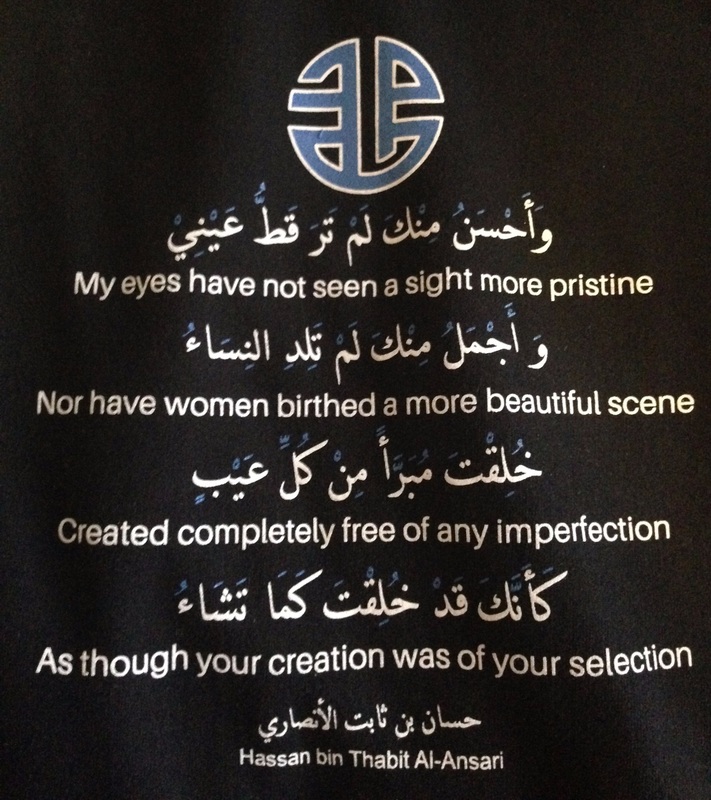
I began with explaining how I look up to Prophets who were known to be transformers of people and of society through the most just means. Time and time again Prophet Muhammad (peace be upon him) inspired people to turn around their lives by treating them like gems. He taught us, “People are metals like gold and silver. The best of them at the time of Jahiliyyah [the time of ignorance] will be the best of them in Islam, if they truly understand…” (Muslim). He emphasized the message that strong qualities in people that can be used for bad can be turned around and used for good causes. While we do not draw pictures of our Prophets, Arabs were people of deep and precise language so it was common for people to express their love for Prophet Muhammad (peace be upon him) through poetry. Since he has inspired me so much through the beauty of his words and characters, I thought I would share a poem that attempts to, but could not even do justice for such a beautiful person.

​
Picture
2 Comments

Split This Rock: A Day in D.C. — Ayesha Shibli

4/21/2016

3 Comments

 
Until this semester, I had never heard of a such thing as a poetry festival. Book festivals, sure—with all the book fairs, author panels, readings—I got that. But what did one do at a poetry festival? Reading and discussing poetry seems like the obvious answer, but I was sure there was more than that.
 
Armed with the Split This Rock event app (which I found out about from ​Yasmine’s blog post) I stalked the presenters, performers and event leaders, scrolled through a list of panels all scheduled at the same time making Sophie’s choice each time I selected one over the other and discussed which panels I wanted to attend with my classmates. Of course, pre-planning is simple—nothing ever pans out quite as you’d expect.
 
Case-in-point: a breakdown of the day-of:
 
7:00 AM: It Begins (also the caption of my first Snapchat of the day)
 “I missed the bus.” Hopkins has a lovely air about it in the early hours of the weekend morning, when no student wakes up with the intention to walk on to campus at 6:45AM. I, of course, having woken up late, ran (walked at a rapid pace) to campus only to find the East Gate of campus completely deserted. Of course, rather than consult any emails or memory of what The Plan was for the day, I convinced myself of the only natural truth: I missed the bus.
 
Very soon after this thought, familiar faces began to trickle in and approach me (or the gate). However, rather than feeling a sense of comfort, I wondered how I would tell them my newfound discovery: We’ve missed the bus.
 
9:00 AM: Arrival at Festival and Adventures to the Middle East [Panel]
Upon arriving at the festival, I realized what had been in the back of my mind while looking at the map I’d been handed on the bus: each panel was in a different building—not just a different room. Panels were set up in different spaces within a three-block radius or so. We would have to walk to each one.
 
Now I’ve heard conflicting opinions on the dispersed panels, however I was personally a big fan of it. We got to walk out into the lovely weather between each panel and see the tiny stretch of D.C. before us that looked all the more beautiful for it. But one issue became glaringly obvious to me within moments of looking at the map: what they fail to check post 4th grade Social Studies is whether you can still read a map after you ace the test. Short answer based on life experience: no. There were no gridlines showing how far Sally’s house was from the elementary school: just a combination of two star shaped intersections and their off-shooting sparks—streets. Even though they were very helpfully up marked map. My only problem was not knowing which way I was on the map. Which led to some very interesting early morning adventures.
 
I must admit now that I am not a coffee drinker, therefore to play up my tired antics as caffeine withdrawal would be disingenuous. However, given my early morning and short nap on the bus ride, my first intended destination was a lucky chance upon Starbucks. This Starbucks, according to the map meant we were very close to the location of the first panel: Now What? Everyday Experience and Resistance in the Middle East, which my early morning astuteness led me to search for based on the building numbers around me rather than by consulting a map on my phone. Across the street from the Starbucks was a building numbered 1300 Connecticut Avenue, making me certain 1301 (the Institute for Policy Studies new office) was nearby. After crossing Connecticut Ave and immediately crossing back, then crossing N St, and again immediately crossing back, we found that 1301 Connecticut Ave. was right next to the Starbucks in the only direction we hadn’t tried: down the street.
 
9:30 AM Panel 1: Now What? Everyday Experience and Resistance in the Middle East
As the first panel I attended at the festival, this panel on the Middle East largely shaped my expectations for the rest of the day. As a panel consisting of academic/poets, there was a collegiate feel of a lecture, paired with panelists unique and informed readings into the works of the Middle East. For the subject matter, I found the format beneficial, however I did feel there was limited Middle Eastern representation. This was not a great concern however, as each of the panelists seemed to be aware of their own distance despite their own positions as translators or burgeoning experts in the field.
 
The panelists’ grappled with the question of how creativity occupies a space on the political stage by exploring the resistance of poetry through subtle language. In fact their emphasis on the intricacies of the Arabic language ushered the audience members and other panelists to seeing images of resistance in the everyday images of family, nature, etc.
I was particularly interested in the take of the panelists, Nomi Stone, and her fieldwork as an Anthropology PhD. candidate researching practices of the US military alongside her study of Iraqi poets and short story writers. As she read a selection from Hassan Blasim’s The Corpse Exhibition and Dunya Mikhail’s “Iraqis and Other Monsters,” she drew emphasis on Arabic works of resistance as a voicing in the world “I am alive and I am not your tool.”

 
11:30 AM Panel 2: The Space to Create: Designing Successful Poetry Workshops for Communities
First things first: This panel was actually amazing. As a Creative Writing teacher at a local middle school, I know how much outside time and planning is required to come up with engaging writing prompts for my students.
 
Basically a workshop on how to hold a workshop, the room was filled to capacity with seating spread out to the floor—tightly packed. Despite the minimal elbow room, the room was filled with energy as so many amazing individuals shared their own experiences and gave each other advice across the room on holding workshops. As a relative newbie, I was just in awe to see so many people share my experiences or offer ways to improve how I've held workshops for my students in the past. 

After a group brainstorming session the audience broke into groups as we designed our own workshops. On groups I will say this—after being introduced to my group-members, I am actually in awe of how a workshop like this brings together people of all levels of experience from an Ohio county poet laureate to a university student studying poetry. On designing a workshop I will go further and say that I am extremely grateful for the lessons and the advice. Being in a setting where I was introduced to so many opinions and experiences helped me to recognize that although I may be starting out, I'll be armed with the experience of my poetry workshop workshop peers as I move forward.

Lastly, a huge shout-out and thanks to the Project VOICE team Sarah Kay, Phil Kaye, Franny Choi and Jamila Woods for making the process of designing a workshop streamlined and helpful and particularly timely, as I go back to teaching next year!

 
1:00 PM Meeting Pages Matam in Person (More details in our interview here)
While the poetry festival itself was a new and unique experience, the absolute most exciting part of my day was between all of the scheduled events of the festival (sorry, Split This Rock organizers, and thank you at the same time for making this meeting possible in the first place!). As students in Dora Malech’s Poetry and Social Justice class at JHU, Rejjia Camphor, and WBS writer and myself were partners in conducting an interview with Pages Matam for this website. Due to time constraints, we had conducted our interview with Pages over email, however after receiving his responses he mentioned that he would be at the festival on Saturday.
 
While our conversation was very helpful for completing our interview for this blog, it was also an excellent summary of this poetry festival itself. It was immediately clear that Pages knows literally everyone—as Rejjia and I were fortunate to meet so many amazing artists who stopped by just to say hi. Upon learning that we were conducting an interview, many asserted that Pages is the perfect combination of poetry and social justice—a perfect interviewee for this class. At a festival like this, Pages was a human reminder of all the stories that need to be told, of the many silences to be broken.

 
2:00 PM Unchained Voices: Giving Incarcerated Writers a Voice
What I found most interesting about this panel was how it could be so much about poetry and expression, without any poetry being read aloud. In some ways, this panel exemplified the aims of a social justice poetry festival drawing attention to the voices of the unheard. 

The two panelists spoke of their experiences not only in teaching creative writing courses to incarcerated individuals, but also of the systemic issues all volunteers face whether it be from program coordinators, grant funding etc. They emphasized their own need to remain apolitical, instead driving activism through writing. By focusing their power on telling their authentic truths, these individuals are able to craft their stories and have a space for their voices to be heard.

You can find out more about the work these panelists do with the Minnesota Prison Writing Workshop
here.

4:30 PM The Adventure Back to Baltimore (or When I Remembered I Had Snapchat and Drained my Phone Battery Recording my Last Hour in D.C. to Make Up for Not Capturing the Festival)
“Life is an adventure best lived with the people you love” This semester I was thrilled to take a poetry class with one of my dearest friends before she graduates. While this semester itself has been an adventure for both of us, our trip back to Baltimore was the best kind—inadvertent.
 
After unknowingly walking to the farther away metro station, passing it by a couple feet and being patiently directed by a fellow pedestrian to look five feet behind us, my classmate, Maysa and I made it to the Metro. Where the real adventure began. Now, everyone knows that trains go in two directions: from Here to There and There to Here. And Maysa, looking in the opposite direction came upon the realization that we were on the wrong train and wrongfully ushered me off the right train. Right before the stop for Union Station—a.k.a. our stop. She continued to advise against the next two trains which both stopped at Union Station (at this point, the blame is solely on me for not asserting my superior directional skills), until the metro which would bring us to Union Station with one minute to our train arrived. Ultimately combination of running as fast as we could, and the sheer luck that the 5:30 PM train was late, brings our D.C. adventures to a close.
3 Comments

Go O's (or: On Celebration) by allison schingel

4/18/2016

1 Comment

 
I like sports.
 
I am not in the least bit athletic, but I was raised in a home where the NBA and the NFL and the MLB were constant fixtures on the TV. We didn’t have cable for most of my childhood, but we (AKA: my parents) could at least watch the nationally broadcasted game, cheer for the home team, bicker over chips and salsa about who was bound for the championship. All of this is helped by the fact that I’m from suburban Indiana, and apathy towards the Pacers or Colts or the school football team means that I’ll struggle for conversation topics with a good portion of my peers.
 
I think it’s easy to dismiss sports as lowbrow, as culturally insignificant. And I can’t really fault that attitude too much. Sports, particularly professional sports, don’t really matter. By which I mean that the Broncos winning the Super Bowl or the Warriors winning 73 games has no real effect on society. Some people are happy. Some people are angry. But it’s a bit frightening to me to think of the millions of dollars poured into this industry whose entire goal is, essentially, just to entertain. Film and literature have the virtues of originality, creativity, social commentary; the sports entertainment world is more or less just a celebration of strong, athletic men and women.
 
But maybe that’s okay. The Orioles went 6-0 last week. It was exciting. I kept hearing the buzz when I was on the bus or shopping for groceries or just scanning through social media. I like sports because they’re deeply communal—sports fandom is comprised of all kinds of people from the same area, the same community, just coming together and cheering for the team that’s supposed to represent them. When the hometown team is succeeding, it feels like a bit like the hometown is succeeding, too. There’s a sense of pride.
 
In class, we’ve been reading a lot of poetry about struggle, about the hardships endured by the historically marginalized and those who have suffered social injustices. I think that’s very valuable work, but it can be trying to keep on reading about sadness and sorrow. As Dora pointed out in class last week, it’s helpful, sometimes, to just celebrate. So I looked for optimistic poetry about social justice. It is, apparently, more difficult than I imagined, but I don’t have an extensive mental repository of poems. Here’s one, though. “I look at the world” by Langston Hughes:
 
I look at the world 
From awakening eyes in a black face— 
And this is what I see: 
This fenced-off narrow space   
Assigned to me. 
 
I look then at the silly walls 
Through dark eyes in a dark face— 
And this is what I know: 
That all these walls oppression builds 
Will have to go! 
 
I look at my own body   
With eyes no longer blind— 
And I see that my own hands can make 
The world that's in my mind. 
Then let us hurry, comrades, 
The road to find.
 
When I see people getting excited about the Orioles, it’s a nice reminder that there really is a lot to celebrate, no matter how small or silly or ultimately inconsequential the thing is. I think that community work is, very often, at the heart of social justice, and so if people from this Baltimore community are out celebrating a few baseball wins, doesn’t that matter? Nothing of real consequence is being accomplished, sure. But if you look at the local sports teams as representatives of the locality, then there is a sense of pride in that. A win won’t propel social justice forward—Langston Hughes’s road to find is almost certainly not the road to the national championship—but it might help some people in the community feel pleased with what their city is accomplishing. And I think that so much of celebration is about unity, and about community, and these are all things that social justice likes to focus on.  
 
There is much to celebrate. For example: The weather is beautiful. Many of us in class just took a trip down to DC, to listen to some marvelous poetry readings and learn about protest and provocation. For us Hopkins students, Spring Fair was this weekend—there was music and fried food and farm animals to pet. Kobe retired with a 60 point game, and the Warriors just got the all time wins record. The Orioles are at the top of the East. People are accomplishing things all around us. There’s a lot to be happy about, I think.

1 Comment

Poetry // Protest - Isabella Bowker

4/17/2016

2 Comments

 
        Those of us in Baltimore know all too well what happened here a year ago. The story of a young man’s murder, of Freddie Gray’s murder (let’s not allow ourselves to forget his name), continues to be part of the public discourse, remains at the center of public tensions, epitomizes what Reginald Dwayne Betts calls “this American dance around death.” Yet even a year later, there are arguments about how to talk about last spring. Some refuse to call what happened to Freddie Gray a murder; they simply call it a death, because death is what happens to everybody at some point, death does not require causation. When they call the end of Freddie’s life simply “a death,” they create a memory of what happened on April 19, 2015 in a manner that is completely divorced from context, from causes before and consequences after. The same is true for how these same people (members of our communities!) speak about the public reaction to Freddie’s murder. (I choose this word, “murder,” deliberately, because murder connotes complicity—on the part of individual(s), of institutions, of society.) The same people who characterize the passing of that young man a “death” (I’m looking at you, CNN) were the same people who called the response a “riot,” as though their actions came out of nowhere, as though the youth and families and community leaders who took to the streets were motivated by nothing other than by seeing destruction. As though there were not a cause worth fighting for. I, however, choose to follow the lead of those who called the marches an Uprising. Because an Uprising is a groundswell, a unanimous decision of having had enough, of flexing democratic muscle to remind society of the inequity of how its foundational principles are applied. The Wikipedia page for last spring’s events in Baltimore pleads neutrality, calls the whole thing, “2015 Baltimore Protests.”
    “It matters what you call a thing,” writes Solmaz Sharif in her poem “Look.” Sharif was a participant at this weekend’s Split This Rock Poetry Festival, and in the hours since attending the festival, I’ve been reckoning with the ways in which talking about poetry parallels the events of last spring’s Uprising. “It matters what you call a thing”—a simple declarative statement, and yet an idea that is full of subversive, dangerous potential—it matters how we talk about things. Our vocabulary has consequences. This is especially true for poets, who, more than the average citizen, are acutely aware of the precise impact of every choice of language. Poets can argue for hours about the placement of a comma, about the multitudinous divergences that can arise from choosing one synonym over another. Poets, in short, believe in the power of language. It matters what you call a thing.
    Reginald Dwayne Betts explores this profound truth in his poem “When I Think of Tamir Rice While Driving,” which he read as part of Saturday’s Featured Poets reading and which can be found in the April 2016 issue of Poetry. Again, parallels—Tamir Rice, Freddie Gray; Cleveland, Baltimore; the pervasiveness of police violence in both instances, violence that supersedes differences in  geography, age, dreams, education. What we talk about when we talk about the killing of a black boy. “Taboo,” writes Betts: “The thing that says that justice / is a killer’s body mangled and disrupted by bullets / because his mind would not accept the narrative / of your child’s dignity” (24-27). Ultimately, he argues, our avoidance of giving things accurate names is a manifestation of our cowardice, of our inability to take the responsibility necessary to change systems and society. Calling the Uprising a riot creates personal distance, removes any sense of ownership from creating the climate that made such a response not only possible, but necessary. “This American dance around death,” as Betts succinctly puts it, is one that sees the source of the problem, but stubbornly calls it by the wrong name.
    Poetry, above all else, is a form of protest. Its very nature breaks every rule of polite conversation. It is at times uncomfortably reticent and intimidatingly eloquent, frequently refusing to give clear answers when the safety of clarity is most desired. Poetry challenges—assumptions, habits, the tools of communication. It matters what you call a thing, and the act of writing poetry is the pursuit of pursuing the most precise representation of reality as is possible.  Which is why writing this blog post, publishing it in such a public setting, makes me nervous and uncomfortable. As a poet in training, I worry that my vocabulary for talking about Freddie Gray, and about poetry in general, is incomplete. Claiming expertise of a subject about which you are not equipped with a proper vocabulary is dangerous and the worst form of arrogance, and I know for certain that I lack the authority to make any claims about reality. These insecurities are compounded by the plain fact of my racial/socioeconomic/educational background. As an audience member of Split This Rock, I saw for myself the pitfalls of what can happen when one substitutes technical mastery for empathy and humility. (I do not wish to name this poet publicly, for I am sure that they are a lovely person. However, several audience members who I spoke to were equally unsure of how to feel by this reading, and the poet’s race (white) vs. the race of their subject matter (black) created a strange, depersonalizing dynamic that was hard to reckon with.) It matters what you call a thing, and this extends to how one should properly analyze a poem or a phenomenon. Misrepresenting reality can have far more pervasive and destructive consequences than simply saying nothing at all.
    Much like poetry, I want to resist concluding with any firm answers. Language is such a fickle entity, always vulnerable to failure, or at least to imperfectness. At Split This Rock, we heard a thousand answers to the same question, and yet I left with more to think about when I arrived. I do, however, want to end on a conversation I had with one of my fellow festival-goers. After Dominique Christina’s earth-shattering performance, as we streamed out of the auditorium on unsteady feet, I remarked to this woman that Christina’s poetry had left me hollowed out. “Me too,” she said. “But that just means when we get filled back in, we’ll be a little bit better off than before.”
2 Comments

Preparing For Split This Rock Poetry Festival: Poems of Provocation & Witness // Yasmine Kaminsky

4/13/2016

1 Comment

 
This Saturday (April 16), our Poetry & Social Justice class is going on a field trip to Split This Rock Poetry Festival in DC. Our instructors have been priming us for this moment since February and, as a poetry festival novice, I am still in awe that a) Split This Rock Poetry Festival exists, b) I’m ‘qualified’ to attend said festival, and c) I didn’t know about a & b sooner. Naturally, I am determined to make the most of this experience. And, naturally, like any good Type-A poetry festival novice will tell you, such an ambition merits a multi-stepped list for the informed and conversational festival-goer. Below is my unofficial, utterly unendorsed, amateurish six-step guide to prepping for Split This Rock 2016. Of course, this guide is by no means a complete resource on its own, so please feel free to click on the hyperlinked text & add your own suggestions in the comments section.
 
 
Step 1: Get acquainted with the who, what, where, when, why, & how’s
 
Split This Rock Poetry Festival: Poems of Provocation & Witness is a four-day (April 14-17) festival in Washington DC that “cultivates, teaches, and celebrates poetry that bears witness to injustice and provokes social change.” The festival, which has become an annual event since 2008, grew from several poets’ shared anti-Iraq war stance, and the festival’s first incarnation took place on the fifth anniversary of the invasion of Iraq. (You can learn more about Split This Rock’s beginnings by reading Catalogue for Philanthropy’s interview with Executive Director and co-Founder Sarah Browning.)
 
Split This Rock’s website describes its members as  “poets who work in the community, in the academy, and both; well known-poets and poets just starting out…a diverse group in terms of gender, race/ethnicity, age, physical ability, sexual orientation, and social class.” It describes its core values as including “dissent and action for social justice,” “diversity and inclusivity,” “accessibility,” and “community building and education”—values, among others, that the festival strives to fulfill through its readings, panels, discussions, workshops, book fair, calls for public action, exhibits, poetry competitions, open mics, spoken word, and more.
 
The festival is an obvious outing for our class, whose syllabus outlines course objectives as being 1) “To acquire a deeper understanding of the intersections of poetry and social justice in historical and contemporary contexts,” and 2) “To grow as a writer and member of literary communities, particularly the Baltimore community, by actively engaging with concerns of poetry and social justice in writing and in person.” I think, too, Split This Rock is an obvious festival choice for the community at large: for anyone who finds fault with the political reality in which we find ourselves, for anyone with the courage to speak out against that reality, and for anyone who wants to find that courage within themselves.
 

Step 2: Stalk Split This Rock’s online presence
 
Of course, Split This Rock’s own website will provide you with a wealth of knowledge concerning the festival, but there are also several other online resources available to feed your pre-festival curiosity for anything, and everything, Split This Rock. Split This Rock has an active Facebook page, Twitter handle, and YouTube channel, as well as what appears to be a burgeoning Instagram account. (Don’t forget to add #splitthisrock2016 to social media posts!) You also can check out their blog and sign up for newsletter updates.
 
Most exciting, the festival schedule is now up! You can view it on their website or download the Split This Rock app for Android or iOS.
 
 
Step 3: Investigate the impetus behind the name “Split This Rock”
 
In case anyone in workshop asks: the festival’s name comes from lines in the second stanza of Langston Hughes’s poem “Big Buddy”: “I’m gonna split this rock / And split it wide! / When I split this rock, / Stand by my side.” Listen to a recording of the full poem here.
 
 
Step 4: Spend some quality time with the mobile app
 
I recommend downloading the Split This Rock mobile app ASAP so that you can learn more about the festival, events, and poets before even arriving in DC. The app offers the following subsections: schedule of events (with the option of filtering events by those you’ve “hearted,” by location, or by category), poets and presenters (with short bios for each & links to the events they are leading), FAQs (including festival locations, general questions, and festival food venues), sponsors, about us, map (which is a must), social media (which links you to Facebook, Twitter, the blog, videos, and more), share status, and share photo.
 
 
Step 5: Obsess over the amazing lineup of featured poets
 
Every year, Split This Rock’s Curatorial Committee (which consists of the festival’s staff, board of directors, and advisory committee) chooses fifteen featured speakers for the festival. The committee seeks “poets who are among the most significant and artistically vibrant writing and performing today” and who “exhibit exemplary public citizenship, as activists, supporters of marginalized voices, and/or in a variety of other ways.” Poets come at varying stages of their careers; some are local, others international. As a collective, they represent diverse identities, and writing content/styles.
 
This year, the featured speakers are Jennifer Bartlett, Jan Beatty, Reginald Dwayne Betts, Regie Cabico, Dominique Christina, Martha Collins, Nikky Finney, Ross Gay, Aracelis Girmay, Rigoberto González, Zeina Hashem Beck, Linda Hogan, Dawn Lundy Martin, Craig Santos Perez, and Ocean Vuong.
 
Between the 14th and 17th, Split This Rock will offer five readings, each featuring three of the writers above. Thursday evening (April 14), Ross Gray, Aracelis Girmay, and Craig Santos Perez will read from their work. Friday evening (April 15), Jennifer Bartlett, Jan Beatty, and Regie Cabico will read from their work as well. Saturday (April 16) brings us two readings! Dominique Christina, Dawn Lundy, and Martha Collins will start off the evening to be followed by Nikky Finney, Ocean Vuong, and Reginald Dwayne Betts later that night. Sunday morning (April 17), Zeina Hashem Beck, Rigoberto González, and Linda Hogan will be our final featured poets to read. (Click on the hyperlinked text to see the Facebook page for that particular reading.)
 
In addition to giving readings, the featured speakers will be leading workshop & events throughout the festival. To learn more about the speakers—and choose whose workshops/readings you’ll attend—you can click on their names above. You can also check out Split This Rock’s Featured Speaker Page, the festival’s blog, its Android & iOS apps, and Poetry magazine’s April issue (in which 11 of the featured speakers’ work appears!).
 
 
Step 6: Learn more about how to stay involved after this weekend & about year-round programming
 
There is no one “right” way of reflecting and acting upon what you will learn from this weekend. Posting photos, blogging, corresponding with contacts you’ve made, revising poems you began in workshop, sharing with a book you bought at the Social Justice Book Fair, wearing a Split This Rock t-shirt to class/work, submitting the festival evaluation Split This Rock will request of you—these are only a few examples of how you can might continue the conversations you will be starting this weekend.
 
Split This Rock also offers a range of volunteer and internship opportunities, some specific to the festival but others concerning overall programming, and you can become a festival sponsor by donating. (Take a look here at Split This Rock’s in-kind donation needs.)
 
Although Split This Rock Poetry Festival is a huge event, it isn’t the only programming the organization offers. Regular events include the Sunday of Love Poetry Series, workshops (currently offered every other Wednesday), a bunch of youth programming (e.g. DC Youth Slam Team & Louder Than a Bomb DMV Teen Poetry Slam Festival), poetry contests and awards, the Poem of the Week Series, publication of a poetry database called The Quarry, and collaboration with community projects. Click here to view a list of upcoming events and here to view a calendar of events.
 
If you take nothing else from this blog post, though, take this: Split This Rock is an opportunity to get out of your comfort zone. Make a schedule for this weekend, and completely change your mind the day of. Strike up a conversation with that cool person in workshop. Read a book that confuses you. Think new thoughts. Write new thoughts. Speak new thoughts. Think, write, speak.
 

Note: Unless otherwise stated, all quoted texts originates from Split This Rock's website.

Works Cited
Split This Rock. Split This Rock, n.d. Web. 10 April 2016.
1 Comment

We were rooting for you.

4/12/2016

0 Comments

 
Nearly a year ago, I remember sitting in my math class as my teacher projected news coverage of State Attorney Marilyn Mosby's press conference to address the murder of Freddie Gray and the future of the officer's involved following the Baltimore Uprising. The class was silent as Mosby acknowledged the tragedy and commended the numerous activists, organizers, and leaders whom courageously stood up for justice in the city of Baltimore.

Nearly a year later, and I am left with the bitter taste of disappointment and abandonment as Mosby now is seen, in the video attached belowed, ignoring valid questions from the community before fleeing to the safety of a black truck. Perhaps, the most unsettling portion of this video is the knowledge that the very victims' family that campaigned for her is now reduced to an unscheduled meeting, unanswered phone calls, and unapologetic nothingness.

As a young black girl born, raised, and educated in Baltimore City I am left to wonder if anyone will truly fight for the safety of my mind, body, and soul.

I was rooting for you.

​Now I am speechless.
​
0 Comments
<<Previous

    Young Writers in Baltimore . . . 

    exploring the intersection of poetry and social justice.

    Archives

    December 2016
    May 2016
    April 2016
    March 2016
    February 2016
    January 2016

    Categories

    All
    Bryonna Reed
    Patrice Hutton
    Poetry & Social Justice
    Rejjia Camphor
    Writers In Baltimore Schools

    RSS Feed

Powered by Create your own unique website with customizable templates.
