• Home
  • Contact
  • Archive
  • Resources
  • Events
  • Home
  • Contact
  • Archive
  • Resources
  • Events
POETRY & POWER

on invalidation - Helena Chung

4/10/2016

1 Comment

 
Earlier this week, The New Yorker published a poem by Calvin Trillin, titled “Have They Run Out of Provinces Yet?” (which I will not link to, instead, Wo Chan’s facebook post about the poem). The same day that posts about Trillin’s poem started popping up on my newsfeed, this video started to pop up as well. In it, Jack Bartholet, Hopkins’ current SGA executive president, can be seen dismissing BSU Vice President, Tiffany Onyejiaka, who was posing a question about diversity to this year's SGA council candidates at a debate that failed to include such a question.

I know that maybe it is easy to dismiss Trillin's poem as satire. He's not making fun of Chinese people, he's making fun of white people who don't know as much as he knows about Chinese food. However, reading it as an Asian American, it gave me a familiar sense of feeling sick. The feeling I got in elementary school when friends would make comments about the smell of my packed lunch, the feeling of hearing those same friends talk about how much they loved Korean Barbecue a few years later. What I mean is, the poem wants to talk about Chinese food, without any Chinese people. Ultimately, being a satire on racism does not protect the poem from itself being racist. Perhaps even, it would be easy to dismiss Jack Bartholet's behavior: after all, it's just student government, what does that matter? But I would say it matters a lot. We're spending our formative college years here. This is our only chance to elect someone who will have some power at Hopkins, no matter how seemingly small or unimportant that power may be. It's frustrating to see someone who wasn't even elected into the position of executive president, use that power to shut down a fellow student who was trying to bring up an important issue that has been consistently ignored.

I am angry with Calvin Trillin. I am angry with Jack Bartholet. But mostly, I am angry at The New Yorker, I am angry at Hopkins. While these incidents have revealed the ignorance of these particular white men, they are ultimately reminders of how these institutions aggressively refuse to acknowledge or even consider people of color. When Trillin's poem was published in the New Yorker--the magazine where every aspiring poet dreams of seeing their work published, when Jack Bartholet rolls around in his swivel chair and tells a black student that we don't have time for a question about diversity, I hear: You are not welcome here. You are not worth our time, our space. You are not one of us. I'm an Asian American poet, I'm a student of color at Hopkins, and this week, my existence felt like one big joke. How foolish am I for dreaming of being published in The New Yorker, when their editors can approve and publish a poem like Trillin's without thinking twice? For that matter, how can the Michener Center still be my "top choice" MFA program, when Dean Young's latest poem saying "I wish I was an ancient Chinese poet" gives me that same sick feeling from before? How could I think for one second that Hopkins, as an institution, is here for me, when my own student government isn't? 

This is the importance of having minorities in editorial roles, in student government roles, the exclusion and erasure of people of color happens at a structural level. To quote Wo's post, "this is why we need organizations like Kundiman, and AAWW, and Kaya Press, and the AALR," this is why we need to vote in our student government elections. So, donate to these organizations, and read poems by actual Asian poets, like Lee Young Lee's Persimmons, or Tarfia Faizullah's 1971, or Fatimah Asghar's america, or Wo Chan's Such As, or Franny Choi's Choi Jeong Min, or Ocean Vuong's Aubade with Burning City, just to name a few that have been giving me life this week.

In class, we've been reading excerpts from Poet's Choice. I am thinking of Hirsch's introduction, in which he says that "[t]he words are marks against erasure" (xv), and I hope reading this work and helping these organizations, will be steps towards dismantling the hegemony. All I know is that I don't want there to be room for the ignorances of another Calvin Trillin, or Michael Derrick Hudson, or Vanessa Place, or Ezra Pound, or Jack Bartholet, and these organizations and poems are the things give me hope that there won't be. 
-------------
Work Cited
Hirsch, Edward. "Introduction." 
Poet's Choice. N.p.: Mariner, 2007. Xii-Xv. Print.
1 Comment

Untitled. // Bryonna reed

4/10/2016

0 Comments

 
"According to Greek mythology, humans were originally created with four arms, four legs and a head with two faces. Fearing their power, Zeus split them into two separate parts, condemning them to spend their lives in search of their other halves.”
― Plato, The Symposium


if half of you were somewhere else
would you know where to look?

what if we were ripped apart at the seams 
and left to wander in search of our stitching?

what if the brazilian coast longs 
for the company of his african love?

partners left in ruins
as the earth shattered...

love nestled among rainforests. 
indigenous tongues whisper love letters across oceans.


waves translate to agony.

mountains rise,
peaks.

looking into the sky for answers.


if half of you were somewhere else
would you go look for it?

or would you trust it to find you?

would you turn over every rock twice and hope there was something that made the third time special?


or do you just write about them?
0 Comments

In A World Where Music Doesn't Exist - Ruth Landry

4/10/2016

0 Comments

 
Last week in our Poetry and Social Justice class, we were prompted to write a poem using a first sentence written by another member of the class. All of these first sentences invoked hypothetical worlds—they all began, “In a world where…” or “If…”
 
Initially, I was not very excited by this prompt. Although I liked the idea of working with someone else’s words (I personally am a big fan of found poetry), I disliked this prompt because of the seeming gimmick of it. The sentence I received—“If music didn’t exist”—seemed to point towards a poem that might have already been written a thousand times, I could imagine it in my head, a poem about a sad world where there is no sense of community, where no one dances, where there is no poetry, where part of our identity is missing. If you Google “If music didn’t exist” some of the results include, “we would all become dead silent” and “the level of emotional, psychological, and spiritual pain would build to intolerable levels” and (my favorite) “people would listen to a lot more books on tape in the car.” To me and to these other internet users, the obvious reaction to the hypothetical music-less world is negative—music contributes so much to people’s sense of belonging, community, and identity that imagining a world without it seems nearly impossible.
 
I know there are so many songs in my own life that really have shaped my own identity--“Annie’s Song” and “Today” by John Denver; “Swing Low, Sweet Chariot” by Etta James; “Tapestry” by Carole King; “Landslide” by Fleetwood Mac; “Nether Lands” by Dan Fogelberg; “Song of the Soul” by Chris Williamson; “My Cathedral” by Chris Rice; “Iko Iko” by the Dixie Cups; “My Cup Runneth Over” by Ed Ames.
 
As I grew up in a very Catholic household, a lot of these songs that I think have shaped me are Christian songs. However, I currently no longer practice Catholicism or Christianity. And yet, these very religious songs about worship and praise and love and God somehow still speak to me and feel very foundational to me. In a world where this music didn’t exist, I wouldn’t be the same person I am now, it seems.
 
And yet something in me resists that. Maybe it is because I’m a contrarian, but I can’t help thinking that my identity is extremely flimsy if it is tied to something as accidental as hearing a specific song in my childhood. There must be something beyond the music itself that allowed it to shape me, made these songs an integral part of myself and my world.
 
Looking through that list again, the answer seems clear—each song on the list is connected with someone I love, or a place in which my life changed, or maybe they have words that express a feeling that I’ve carried with me for years. “Annie’s Song” and “Today” both remind me of summers spent in the woods Tennessee (“Annie’s Song” begins, “You fill up my senses like a night in the forest”); I have vague memories of my mother and grandmother singing “Landslide” and “Swing Low, Sweet Chariot” to me as a child; “Nether Lands” offers a vision of the world and nature and solitude that I retreat to when I feel overwhelmed. Even the religious songs such as “Song of the Soul” and “My Cathedral” still resonate with me, informing me how I would like to shape my life and treat my friends.
 
I think that even if music didn’t exist, we would still find ways of expressing history and play in the same way that “Iko Iko” does. I think we would be able to speak of our love of nature and God in a way that is just as beautiful as “My Cathedral.” I think I would have other connections to the memories of people and places that I love besides these songs. I think that a world without music would be just as beautiful as this one, because we would find the beauty and community that we seek in music in other locations.
 
And I think that my mysterious partner who gave me the prompt “If music didn’t exist” probably understood this better than I did. After all, that is what the creation of hypothetical worlds does; it allows us to examine what we take for granted and imagine how things could be. And for a contrarian, I suppose I'm surprisingly optimistic--I think that the world could always be better, will always be moving in a better direction. To me, it is productive to imagine these hypothetical worlds in positive, optimistic ways. Though my poem might be about sometimes perhaps trivial, this prompt opens itself to imagining worlds where sexism, racism, homophobia and their respective tool kits don't exist. I want poems about a world where photoshop doesn't exist, where guns don't exist, where abortion isn't necessary, where sexual assault doesn't happen. It sometimes seems impossible to imagine a world without racism, sexism, poverty, violence and other problems; but a world without music seems similarly "unimaginable"--and the truth is, it really isn't.
 
I’ve included a draft of my poem below.
 
If music didn’t exist we would listen to each other breathing.
I would hear the Ave Maria in my mom’s yawn
and Tchaikovsky in his laugh. As I walk to class,
I would skip to the sound of speeding cars
instead of Ke$ha; at night, we would dance
to the clanging of my heater, and kiss
as the wind rattles in my windows.
If music didn’t exist, a concert
would be my roommate’s shoes against pavement,
alone on her 6AM Baltimore runs, a symphony
would be a hundred people on the phone with their moms.
When it rained, we would separate--
the ballet dancers and classical enthusiasts outside,
for the soft hush of running water; and inside
modern and experimental, staccato on the roof.
We would spend hours in libraries, listening to pages turn,
waste quarters and paper at Kinkos just to hear printers whir,
close our eyes when we shoot fireworks--
what matters is the sharp scream, not the glow.
If music didn’t exist, we wouldn’t be embarrassed by burps.
Exciting new sounds, we would fill our SoundClouds
with farts and queefs and coughs
and we would love the sounds our strange bodies make,
upspeak and vocal fry would be heralded,
“like” would be loved, and instead of singing,
we would attach stethoscopes to microphones,
and let the world hear our hearts beat.
0 Comments

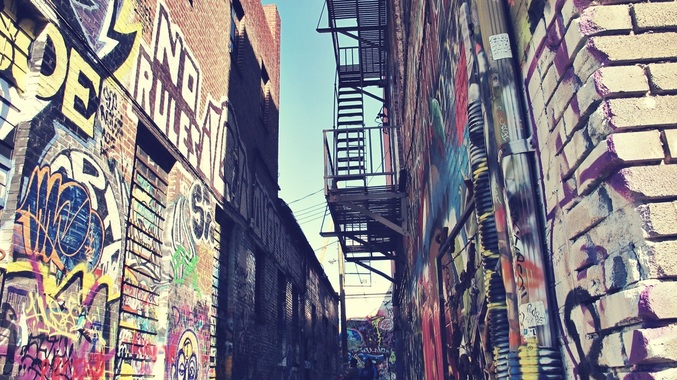
In Search of ars poetica in baltimore - Nare N.

4/4/2016

4 Comments

 
When I complained to my friend Ms. Cade about the lack of poetry in life, she whole-heartedly agreed, which was a shame. Maybe had she disagreed, I wouldn't set out on this adventure to find poetry in an ordinary Baltimorean day, as to disprove my own point. And then I wouldn't have to get stuck in a pre-apocalyptic mall or visit a tattoo parlor in the middle of nowhere. And then I wouldn't feel out of place for liking Baltimore so much now at the cusp of graduation.
     Speaking of graduation, I should probably introduce myself, since I'm gonna essentially make it painfully personal and tell you about my day. I'd say I occupy the "exotic white" category, being from Armenia. For all intents and purposes of this article, I'm an amateur: I checked out a decent DMC camera, but I'm not good at photography and I'm majoring in Writing, though wut r words even and howz u do dem. I guess what I'm trying to say is captured pretty well in a text I sent to someone in The Poetic Day's morning in response to her analysis of my boy trouble. "my larger struggle is that of a self incapable of love. incapable of choosing a side, incapable of reconciling difference and sameness, the outer and inner view, the categories and the cases, the frames and language with being lol. for all the facade u can't blame me for being scared" It applies well to the challenge of this day, I think. Words fail us all the time. It's in their nature to seek their own demise. When you say something, its opposite is immediately summoned and that shadow follows it around. When you say something, from the whole world of what was "unsaid" you choose the opposite statement and say, "Yeah, especially not you."
    Baltimore is not poetic, but at this point in contemporary poetry we've declared everything poetic "unpoetic." Having a camera made me uncomfortable in a Sontagian way. I felt like I was framing all the wrong things; filtering, sacrificing truth to aesthetics. One day I'll be better at imposing frames and won't be obsessed with what's left on the margins. One day language and I, Baltimore and I will figure it out. Or did we already on April the 1st, 2016?
Picture
  No rules!

Read More
4 Comments

My "Poet's Choice" - Mia capobianco

4/3/2016

0 Comments

 
While reading selections from Edward Hirsch’s “Poet’s Choice” last week, I began thinking about which poems I would select if I were to write my own version. During this process I realized that I am not great at keeping a catalogue of the art that inspires and impacts me, and I’d like to use this space as an attempt to begin that catalogue. I have decided not to limit myself to poetry; I am a student of the visual arts as well as a student of art history, a music enthusiast, and so on, and I believe it is fruitful (and natural) to draw parallels between various artistic mediums. Thus, I will place each selection in conversation with a piece of activist literature. So, here it goes, my (abridged) Poet’s Choice:
​

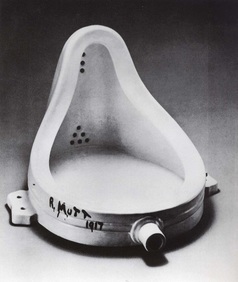
Marcel Duchamp’s Readymades and Walt Whitman’s Leaves of Grass
​
Marcel Duchamp's
Marcel Duchamp's "Fountain" - via simonbrushfield.com
​
​            Marcel Duchamp was a French artist (and naturalized American citizen), whose work has undoubtedly changed the course of art history. One of his most influential innovations is the concept of the readymade—an everyday (usually mass produced) object or compilation of such objects taken out of its original (read: practical, intuitive) function, sometimes modified slightly, and labeled as art.
            Duchamp’s most famous (or, at the time of its creation, infamous) readymade is entitled Fountain. To make this work, Duchamp simply signed a urinal R. Mutt—R. referring to the French slang for “moneybags” and Mutt referring to the manufacturer. Using this synonym, he submitted the work to the 1917 Society of Independent Artists.
            Walt Whitman is often hailed as the “father of free verse.” He first gained attention as a poet when he self published Leaves of Grass in 1855. Whitman wrote sprawling, lyrical lines that seemed to go on forever and, when linked together, formed a new kind of epic. His free verse was unbounded, and truly “free.” The poems in Leaves of Grass also took up controversial themes, namely those of sexuality.
            Both Duchamp’s readymades and Whitman’s Leaves of Grass challenged the standards of art at the time. Duchamp’s Fountain was rejected by the Society and widely criticized for being obscene, as was Whitman’s Leaves of Grass. Both pieces attacked what was seen as the “proper” form of art making, threatening the validity of artistic institutions. However, both pieces were highly regarded by a handful of contemporary artists and are now held up as some of the finest works of their time. Duchamp’s readymades were (and still are) considered commentary on what art truly is, criticizing the artistic tradition and redirecting it in one stroke. Similarly, by essentially breaking all of the rules of poetry at once, Whitman created a new space for provocative poetry that did not have to follow conventions in form or in subject.


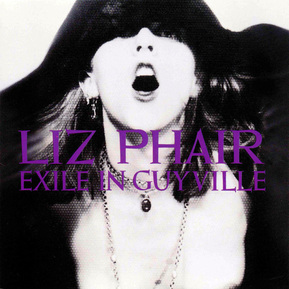
“Exile in Guyville” by Liz Phair and Lucille Clifton’s Poetry 
​
Liz Phair's
Album artwork for Liz Phair's "Exile in Guyville" (1993, Matador) - via stereogum.com

            “Exile in Guyville” is the title of Liz Phair’s debut studio album from 1993. The 18-track album is a lot of things all at once—an indie rock record, a response to the Rolling Stones album “Exile on Main St.,” an exploration of what it is to be a young woman, vulnerable yet confrontational accounts of experiences real or imagined. The lyrics often reference romantic relationships, the entertainment industry, and sexuality.
            One of the most striking songs on the album is entitled “Flower.” Like the album more broadly, the track is operating on several levels. It is a droning sexual monologue by a woman in an essentially reduced-to-robot state. She sings about how much she wants whomever she is addressing, yet exhibits essentially no enthusiasm with her tone. She mentions how infuriating she finds this person, yet she is filled with desire. Furthermore, her message has very dominant overtones (“I’ll fuck you till your dick is blue,” “I want to fuck you like a dog / I’ll take you home and make you like it,” etc.). I see this song as a sort of subversion of the male gaze, particularly in terms of women in the entertainment industry.
            Lucille Clifton’s work likewise has many themes—sexuality, womanhood in the domestic realm, history/ancestry, race and race relations, to name a few—that function independently and in conjunction with one another. Her work is notably candid and no-frills, stripped of capitalization, complicated syntax, and the likes. Clifton, much like Phair, hides behind nothing.
            Both Clifton’s poetry and Phair’s “Exile in Guyville” are markedly vulnerable—experiences and thoughts out in the open—without being confessional. They each speak of taboo subjects without trepidation (look, for example, at Clifton’s “wishes for sons” and Phair’s “Divorce Song”). Furthermore, each of them employs unusual images in their work (and for Phair this extends into her complicated guitar lines, which are sometimes so upbeat that they seem to contradict the lyrics, and at others so ambient they seem to at once envelope the song and melt into the background). Check out Clifton’s “cutting greens” for one of my favorite examples of her odd and compelling imagery, and give “Dance of the Seven Veils” (one of my favorite tracks on the album) for an example of Phair’s brilliant lyrics, full of strange images like “You can rent me by the hour / I know all about the ugly pilgrim thing / Entertainers bring May flowers.” Ultimately, these two artists’ work are required reading/listening because they subvert our expectations; it is not often that one encounters a woman chanting about her sexual prowess or speaking about death, violence, and segregation in regards to kale and collard greens. This art is smart, timeless yet of their times, and so refreshing.

​
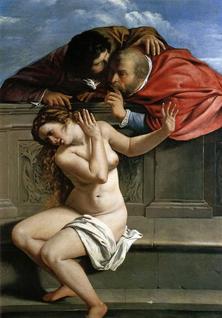
“Artemisia and Susanna” by Mary D. Garrard and “The Difficult Miracle of Black Poetry in America or Something Like a Sonnet for Phillis Wheatley” by June Jordan
Susanna and The Elders
Artemisia Gentileschi's "Susanna and The Elders," 1910 - via cavetocanvas.com

            Mary D. Garrard’s “Artemisia and Susanna” is an essay in Feminism and Art History: Questioning the Litany that explores Artemisia Gentileschi’s Susanna and the Elders, a painting from 1610. It has long been assumed that the painter’s father, an accomplished painter himself, was the true author of this work, as Artemisia was only seventeen at the time of its completion (and because art historians have a habit of discrediting the achievements of non-male artists). The essay argues that Gentileschi did, in fact, paint this work, citing the way Susanna is depicted.
            The scene Gentileschi portrays comes from a biblical story in the Book of Daniel. The story goes: two older men watch Susanna in her garden, then decide to accost her and demand that she have sex with them, or else they will say she was engaging in lascivious activity. She refuses, and is about to be put to death for promiscuity when the men are found out. It is intended to be a story about pious virtue (refusing the men) and justice (the men are found out). However, historically, the scene of so-called “seduction” was constantly selected for portrayal in painting. In these examples, the men are seen as daring and adventurous, while Susanna is overtly sexualized. Essentially, a horrific scene about rape becomes an opportunity to sexualize the victim of violence.
            Gentileschi’s painting, however, does away with this tradition, showing the men as threatening and Susanna as repulsed, contorted away from the men in horror. She also does away with the lush garden scenery, which traditionally suggested eroticism. Gentileschi was a victim of rape herself, and the threat of sexual violence was constantly looming over her (via the unwanted advances of her father’s colleagues and her teachers).
            June Jordan’s “The Difficult Miracle of Black Poetry in America or Something Like a Sonnet for Phillis Wheatley” is an essay that discusses the life and work of “the first Black human to be published in America.” Jordan speaks of Phillis Wheatley’s history as a slave for the Wheatley family, then goes on to examine her poetry in more depth. Jordan notes the racist phraseology Wheatley involuntarily assimilated from her education. Then, Jordan points to phrases, such as “intrinsic ardor,” that suggest Wheatley was covertly asserting her autonomy.
            When her white sponsor (Mrs. Wheatley) died, she fell off the radar of the literary world. She experienced marriage, the death of three children, and wanted to publish a second volume of poetry. However, without white sponsorship, this never happened. We do not know about the pain and love Phillis Wheatley experienced; we do not know much about her life from her poetry, because the only poems that had the possibility of being published had to appease a society wrought with institutionalized racism.
            I love these essays because they call into question the accepted view of great works by closely examining the specific context of their making. Gentileschi and Wheatley are both considered prodigious and genius, yet without the presence of white personal sponsorship (Gentileschi’s father and Wheatley’s owner) and institutional sponsorship (western canonization), their achievements are seen as invalid. Furthermore, each of these women created work specific to her personal experiences, and it is crucial to examine the context in which these works were made in order to understand historical bias. These biases permeate society, and they greatly effect how people view artworks today. Therefore, it is important to understand the lens through which art is presented, so that we might subvert that lens, and see the work for what it truly is.

​

—Mia Capobianco
0 Comments
Forward>>

    Young Writers in Baltimore . . . 

    exploring the intersection of poetry and social justice.

    Archives

    December 2016
    May 2016
    April 2016
    March 2016
    February 2016
    January 2016

    Categories

    All
    Bryonna Reed
    Patrice Hutton
    Poetry & Social Justice
    Rejjia Camphor
    Writers In Baltimore Schools

    RSS Feed

Powered by Create your own unique website with customizable templates.